At a Glance
Layered slab system delivers multiple benefits — combining radon diffusion, moisture/air control, and radiant-ready prep in one compact assembly.
Inverted Heat-Sheet® R10 panels act as a passive radon diffusion layer — eliminating the need for gravel or a separate vent mat, while adding rigidity and stability.
Future-proofing with rough-ins — low-cost rough-ins for both radon mitigation and radiant heating ensure flexibility without costly retrofits later.
Efficient, durable install — a two-person crew completed a radon- and radiant-ready slab in under 3 days, showing this approach is practical even in challenging retrofit conditions.
Project Case Study | Litebox Inc. | Winnipeg, MB
PROJECT SNAPSHOT
Type: Deep energy retrofit of a 1904 triplex
Location: Winnipeg, MB — a high radon risk zone
Focus: Health, comfort, and energy-efficiency through a sub-slab rebuild
Solution: Dual-layer Heat-Sheet® Heavy system for passive radon mitigation and radiant floor prep
Result: Durable, airtight, radon-ready slab installed in under 3 days with a 2-person crew

Why This Project Matters
Winnipeg is no stranger to radon — nearly 1 in 4 homes test above Health Canada’s guideline of 200 Bq/m³. Radon is the leading cause of lung cancer in non-smokers within Canada, and once it enters a building, it’s tough to manage without proper mitigation.
This made radon readiness a top priority for Litebox founder Grant Walkin, P.Eng., as he tackled a deep retrofit on his own home. The original basement didn’t test high — yet — but Grant wasn’t about to wait for a problem after he made the building airtight as part of the deep energy retrofit. Instead, he built protection in from the start with a layered sub-slab system that’s ready for anything.
And the prep didn’t stop there. Grant smartly installed two rough-ins: one for a future radon mitigation system and one for an in-slab radiant heating system. Neither is operational today, but both can be activated on demand if needed — with no costly retrofit down the road. It’s a proactive move that’s far cheaper now than it would be after the slab is poured. Plus, since the expensive mechanicals aren’t in place yet, the up-front cost was surprisingly modest.
Meet the Builder
Grant Walkin is a PHIUS-certified Building Envelope Engineer and founder of Litebox Inc., a high-performance consulting firm based in Winnipeg. With a focus on deep energy retrofits and optimized building enclosures, Grant brought both professional expertise and personal stakes to this triplex renovation.
His excavation strategy wasn’t just about gaining ceiling height or adding a fourth unit — it was about aligning with his four-pillar performance framework: comfort, health, durability, and energy-efficiency. The slab rebuild tackled three of those head-on.
The Retrofit Challenge
Working in a 120-year-old structure comes with quirks, constraints, and plenty of unknowns. To make the lower level livable, with proper ceiling height, dry, and comfortable, Grant dug down two feet and rebuilt the slab from scratch. His targets were clear:
- Create a insulative, stable base
- Integrate a passive radon diffusion layer
- Seal and waterproof the assembly airtight against moisture and soil gas
- Prep for a future in-slab hydronic heating system

The Sub-Slab Strategy: Simple, Layered, Durable
- Radon Diffusion Layer – Inverted Heat-Sheet® Heavy R10
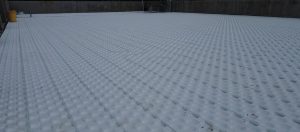
Instead of loose-fill gravel or a separate vent mat to serve as a capillary break, Grant installed Heat-Sheet Heavy R10 panels upside down. The nodules created built-in air channels for passive soil gas movement — all while delivering structural stability and insulation.Bonus #1: The 3.25″ panel thickness added crucial rigidity. Any thinner, and the ship-lap joints might have cracked during installation.
Bonus #2: The air voids between the nodules may also serve to absorb some seasonal ground swelling movement, preventing movement of the slab-on-grade; this is common with Manitoba’s clay soils.
- Air & Moisture Barrier – Subterra Plus® 1″
On top of the inverted panels, Grant laid down a full layer of Subterra Plus, sealed along joints with Evoseam Tape and penetrations with Rothoblaas Black Band, and detailed around penetrations with 3M 3015 TWF. This created a continuous air/vapor/water control layer — essential for radon resistance, moisture control, and long-term indoor air quality. - Radiant-Ready Layer – Heat-Sheet Heavy (Standard Orientation)
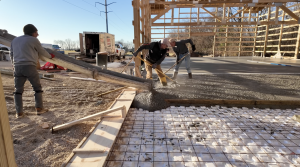
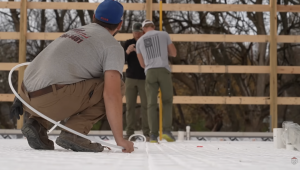
To cap it off, Grant added a second layer of Heat-Sheet Heavy in the upright orientation with ½” Uponor Wirsbo hePex. The tubing was installed in a single 300′ loop, serving only the kitchen, bathroom, and perimeter. Because this is a high-performance build with minimal heat loads, the remaining areas were left uncovered by PEX. Despite the crew walking and working on the panels throughout the install, they held up flawlessly with zero damage.

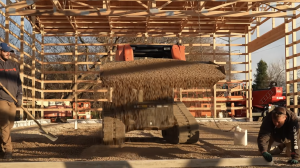
“Working the panels back and forth over a thin layer of 10mm pea gravel helped the nodules settle into place for a perfect level. It felt stable, locked together well, and gave us both a capillary break and radon collection cavity should it need to be taped into by the roughed in radon pipe to actively depressurize the sub-slab cavity for active radon mitigation.”
— Grant Walkin
INSTALLATION SNAPSHOT
Area: ~650 sq ft
Crew Size: 2 people
Timeline: <3 days for excavation, install, sealing, and detailing
Performance: Airtight, stable, radon-ready, radiant-ready — no panel breakage
Lessons for Builders & Designers
- Inverted Heat-Sheet Heavy is a smart substitute for gravel and radon mats
- Subterra Plus® simplifies the air/vapor control layer and speeds sealing without the need for another membrane
- Two-person crew handled the full system with ease — ideal for tight retrofits
- Rough-ins for radon and radiant heat are low-cost, high-impact additions that future-proof your slab


Don't miss a thing!
Subscribe for exclusive content, insider industry news and limited edition webcasts.
Wrapping It Up
This retrofit wasn’t just about making an old basement livable. It was about raising the standard for health, comfort, and resilience — all before the slab was even poured. With Heat-Sheet Heavy doing double duty for radon protection and radiant-ready prep, Grant’s system is clean, layered, and built to last.
By installing both radon and radiant heat rough-ins now, Grant avoided future headaches and high retrofit costs. It’s a forward-thinking move that underscores the value of building smart — and staying ready.