At A Glance
- Aluminum oxygen protection: Henco PEX-AL-PEX uses a welded aluminum layer between two layers of PEX, creating an oxygen-tight barrier designed to help protect closed-loop radiant heating components from corrosion.
- Built and tested for long-term performance: Henco has used the same tubing formulation since 1992 and supports it with ongoing pressure, thermal-cycle, and manufacturing quality-control testing.
- Designed to stay put: The aluminum layer gives PEX-AL-PEX greater dimensional stability and less spring-back than conventional PEX, helping the tubing hold its shape during installation.
- A natural fit with Heat-Sheet: Shape-retaining PEX-AL-PEX complements Heat-Sheet’s multidirectional tubing channels, allowing installers to walk tubing into place without staples, ties, or taping in most runs.
- System support from design to installation: Underfloor Solutions provides Henco tubing, manifolds, fittings, accessories, and radiant system design support, with Heat-Sheet available as part of a complete package.
Radiant floor heating lives or dies by what’s inside the loop. One of the most overlooked but critical components in any hydronic system is the tubing itself — specifically, whether it’s built to keep oxygen out. Oxygen intrusion into a closed-loop heating system can corrode boilers, pumps, valves, and other ferrous components over time, quietly shortening the life of an otherwise well-designed system.
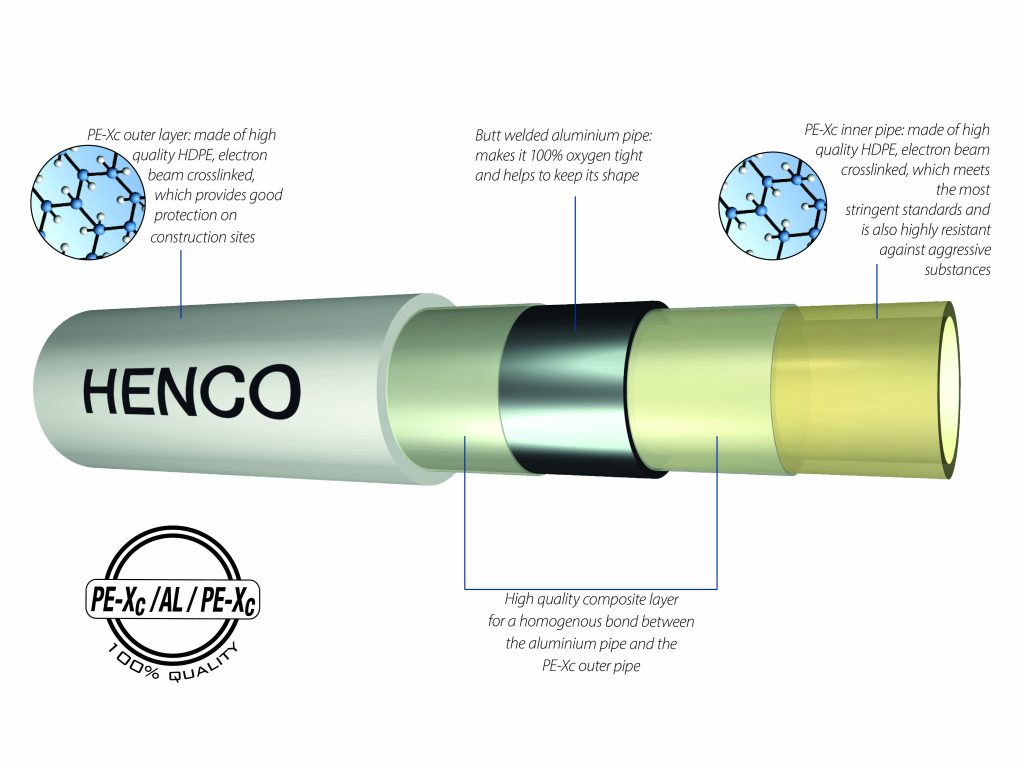
Henco has built its reputation on PEX-AL-PEX tubing — a multilayer pipe with a welded aluminum layer sandwiched between two layers of PEX, offering a different approach to oxygen barrier protection than the more common EVOH-coated PEX-A or PEX-B products. Underfloor Solutions is Henco’s exclusive U.S. wholesale distributor, supplying contractors, HVAC professionals, and DIYers nationwide.
In this interview, we sat down with representatives from both Henco and Underfloor Solutions to unpack how the tubing is engineered, how it performs against industry standards, what makes it different from other oxygen-barrier products on the market, and what contractors and homeowners should know before specifying it for a project.
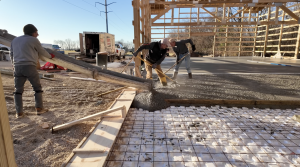
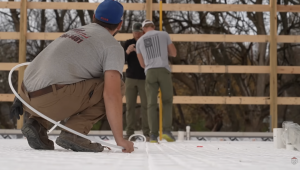
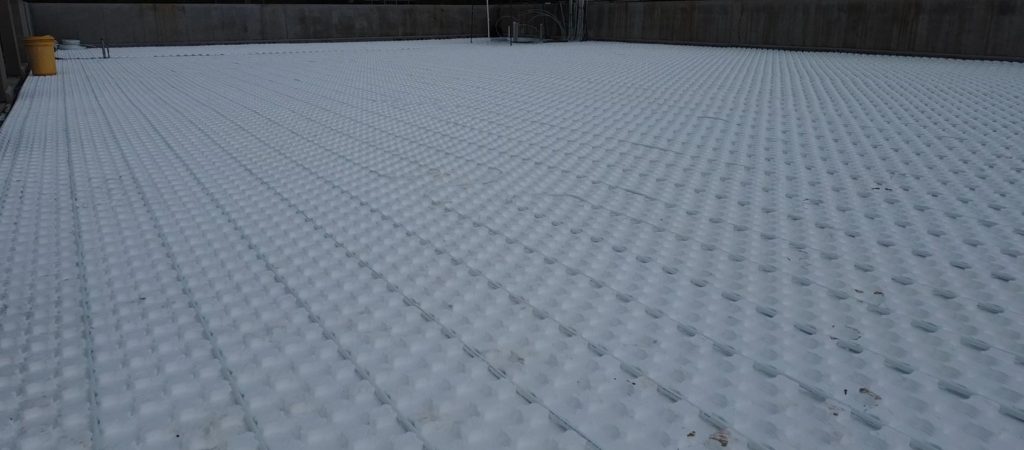
The conversation also touches on how Henco tubing fits into a broader installation system, particularly its use alongside Heat-Sheet panels from Logix Brands. Heat-Sheet is a preformed EPS insulation panel with a molded, multi-directional tubing channel grid designed to accept 1/2″, 5/8″, or 3/4″ tubing without the need for staples, ties, or taping in most runs. Because Henco’s PEX-AL-PEX tubing holds its shape after uncoiling rather than springing back like standard PEX, it’s a natural fit for Heat-Sheet’s “walk it into place” channel system — reducing the labor and rework that can come from tubing fighting against the panel grid during installation.
Part One: Engineering and Manufacturing — Questions for Henco About the Product
Logix Brands: Henco’s tubing uses an aluminum layer rather than an EVOH coating as its oxygen barrier. Can you walk us through how that layer is bonded to the inner and outer PEX layers, and how you prevent delamination over time or with thermal cycling?
Henco: We use a multi-layer tubing design. The inner layer is PEX that’s cross-linked by electrons — what’s called PEX-C. We apply an adhesive, form the aluminum around the tube, apply adhesive again, and then form the outer layer of PEX onto the tube. The adhesive is the critical point, because aluminum and PEX expand and contract at different rates when heated or cooled. It must be strong, but also flexible enough to let the layers slide slightly against each other during that expansion and contraction.
We’ve used this same formulation since 1992, and it’s been unchanged since then. We produce about 400 million feet of tubing a year, and we have a long track record of installations with no failures tied to this construction
Logix Brands: Henco markets its tubing as meeting BSRIA-recommended oxygen levels. What’s the actual oxygen diffusion rate, and how does that compare to the DIN 4726 standard that most EVOH-barrier PEX products cite?
Henco: Most EVOH-barrier products are rated according to DIN 4726. That standard allows a product to be classified as oxygen-tight once it reaches a certain threshold, but that doesn’t mean it’s a 100% barrier. DIN 4726 permits up to 3.6 milligrams of oxygen per square meter of tubing per day, depending on temperature. Over the course of a year, on an 8-loop system, that adds up to roughly ten times the level that organizations like BSRIA recommend. Our tubing uses aluminum as the oxygen barrier instead, and aluminum is 100% oxygen-tight — meaning zero milligrams of oxygen enter the system.
Another difference is where the barrier sits. Our aluminum layer is on the inside of the tube. Some manufacturers apply the EVOH coating to the outside, which means that during handling — being dragged over rebar, stepped on, or handled during installation — that coating can get scraped, so by the time the tubing is installed, its real barrier performance can be lower than the spec sheet suggests. Because our aluminum sits on the inside, that risk doesn’t apply — we don’t lose any of that 100% oxygen tightness during installation.
Logix Brands: Is the aluminum layer continuous and seamless, or is it overlapped and welded along a seam? If it overlaps, is there any long-term risk at that seam?
Henco: It’s butt-welded, not overlapped — the aluminum is folded together and welded along the seam. During production we run a series of checks: cameras and sensors measure the weld continuously along the full length of tubing, and we also measure where the aluminum sits within the tube. We check inner and outer diameters after the first PEX layer, again after the aluminum is formed, and again after the outer PEX layer is applied, so we know the aluminum is centered at every point around the circle. That gives you a properly round tube, which you don’t get with an overlapped seam — overlap tends to produce a tube that’s not quite round, and often a bit thicker on one side. That makes it harder to seat cleanly into a channel-based installation system, since it wants to pop out on the thicker side. Some manufacturers try to compensate by thinning the plastic on that side, but that introduces its own risk of the plastic opening under stress.
All measurements happens in-line during production, not after the tube is coiled — the tube is extruded, cooled, and measured again after every layer is added, so we know the inner and outer diameters at every stage of the process.
Logix Brands: What’s the tubing’s rated pressure and temperature curve, and does that rating change at the fittings compared to the tube body itself?
Henco: The tubing is rated at 145 PSI at 203°F, which is higher than most products on the market. The fittings carry the same rating, though in a floor heating application you’re typically only using fittings at the manifold. The manifold itself is rated lower — 87 PSI at 158°F — by design. The idea is that the manifold should fail before the tubing does, since the manifold is easy to replace, while tubing embedded in concrete is essentially impossible to replace once it’s damaged.
If a leak does occur under a slab, leak-detection equipment is the most reliable way to pinpoint it. Without that equipment, one option is to isolate one loop at a time and watch for a pressure drop to identify which loop is leaking — though you’ll still need to narrow down the exact location within that loop.
Logix Brands: What warranty do you offer on the tubing — how many years, and does it cover material only, or labor and consequential damages if a failure occurs?
Henco: We offer a 10-year warranty that can cover consequential damage, depending on our findings — we require the failed product returned so we can test it. It’s worth reading the details of any warranty closely; some manufacturers require customers to complete specific training courses or the warranty doesn’t apply. Ours doesn’t carry that requirement, but we do need the defective product back so we can run testing on it before determining coverage.
Logix Brands: How do you test each production run for barrier integrity and burst pressure before it ships?
Henco: During production, sensors measure the inner and outer diameter, the aluminum seam, and the position of the aluminum within the tube. Beyond that, we pull samples daily from every production line for further testing: a 22-hour test, a 165-hour test, and a 1,000-hour pressure test, all run at higher pressures and temperatures than the tubing is rated for — typically at 203°F, with some samples tested at 290 PSI and others at 580 PSI. We hold about 40 certifications across different countries, each with its own requirements, so we keep all that test data on file in case of an audit.
We also run a thermal cycling test, since rapid temperature swings put the most stress on the tubing in terms of expansion and contraction. A section of tubing is cycled between roughly 70°F and 203°F for 5,000 cycles, with each swing happening within one or two seconds — closing off one line of warm water and immediately opening a line of cold water, rather than the gradual heating and cooling you’d see in a real system. It’s a more aggressive test than the tubing would ever see in practice, but it’s a good way to validate durability.
Logix Brands: What’s the expected service life of the tubing, and is that backed by field data or third-party lab testing, or is it primarily based on accelerated aging simulations?
Henco: We’ve been manufacturing this same tubing formulation since 1992, so we have 34 years of actual field data — not just accelerated simulations. Some manufacturers have only been producing tubing for five years and market a much longer lifespan without that track record behind it. On top of the field data, independent laboratories run regression testing on our behalf — ours is done by SKZ in Germany — projecting performance out to 50 years. Tubing tested at 158°F after that 50-year regression still holds pressure above its rated working pressure, which is why we’re confident in a service life beyond 50 years.
Logix Brands: PEX-AL-PEX has a much lower expansion coefficient than standard PEX-A or PEX-B. Does that change installation requirements — expansion loops, fastening spacing, or transitions at the manifold?
Henco: The aluminum layer makes installation easier. Unlike standard PEX, our tubing doesn’t spring back after uncoiling — it holds its shape, so once it’s placed into a channel system it stays put rather than popping back up. That also means fewer staples are needed, especially at the bends.
The expansion difference matters most in joist-bay installations, where the tubing sits in aluminum transfer plates. Tubing with a higher expansion rate can squeak as it expands and contracts through heating and cooling cycles, which is a common complaint from occupants. Our lower-expansion tubing doesn’t create that noise in the transfer plates, and the same holds true for transfer plates installed under wood flooring.
Underfloor Solutions: It also shows up during installation itself. On a warm summer afternoon, tubing expands, and if the temperature drops significantly overnight before the concrete is poured, standard oxygen-barrier tubing can start to curl, pull staples loose, or pop out of the channel system as it contracts. With the aluminum layer, that doesn’t happen — the tubing stays put regardless of the temperature swing.
Logix Brands: What connection systems are compatible with your tubing? Is it locked into Henco-specific fittings, or does it work with standard PEX-AL-PEX fittings from other manufacturers?
Henco: The tubing is manufactured to the ASTM F1281 standard, which is the sizing standard for the North American market — not a proprietary Henco size. Any fitting certified to ASTM F1281 will fit our tubing. That certification matters: the Plastics Pipe Institute has noted that a fair amount of tubing entering the market carries no certification at all, which raises questions both about fitment and overall product quality. Our certification is listed on the NSF website as well as our own, and it guarantees compatibility with any ASTM F1281 fitting.
Logix Brands: How does the aluminum barrier layer hold up with glycol-based heat transfer fluids, or in systems that see frequent freeze/thaw cycles or drain-downs?
Henco: Glycol is compatible with the system, up to about 45% concentration. We recommend using it in any area with a real freeze risk, but not more than necessary — glycol doesn’t transfer heat as well as water, so higher concentrations reduce output. It’s still worth using to protect the system, since a frozen system risks bursting and can be difficult to thaw out. The aluminum layer itself is unaffected by glycol, and because it’s sandwiched between the two PEX layers, neither the water nor the glycol ever actually contacts it.
Water quality matters too — we recommend clean water rather than well water, since debris can clog the system over time. The aluminum barrier also prevents oxygen from entering the system in the first place, which avoids magnetite formation — the black corrosion sludge that can clog pumps and shorten boiler life. So beyond blocking oxygen intrusion directly, the barrier layer helps protect water quality and, in turn, the mechanical components in the loop.
Part Two: Sourcing, Logistics, and Support — Questions for Underfloor Solutions
Logix Brands: As the exclusive U.S. wholesale distributor for Henco, what happens if there’s a supply disruption overseas? Do you carry buffer inventory, or are lead times directly tied to international shipping schedules?
Underfloor Solutions: We carry a large buffer inventory — a wide selection of tubing, manifolds, and other Henco accessories — so we’re prepared for most disruptions. Under normal international shipping schedules, our typical lead time to bring in additional products is about six weeks.
We stock various tubing sizes, along with stainless steel and composite manifolds, fittings, and other installation accessories. It’s the same multi-layer tubing throughout, which also has other applications beyond radiant heat, such as air lines.
Logix Brands: What sizes and roll lengths do you keep in regular stock versus what needs to be special ordered?
Underfloor Solutions: Most projects use half-inch tubing, which we stock in 250-foot, 300-foot, and 1,000-foot rolls. We also carry 5/8-inch tubing in 450-foot rolls, 3/4-inch tubing in 500-foot rolls, and 1-inch tubing in 300-foot rolls. One detail worth noting: at 5/8-inch and larger, the inside diameter of our PEX-AL-PEX tubing is larger than what you’d find in a standard oxygen-barrier PEX-A or PEX-B tube of the same nominal size. That means less pressure drop, which allows for longer runs and a more efficient system overall.
We also carry manifolds ranging from 2 loops up to 12 loops, and our composite manifolds can be expanded to reach 15 loops. Sizing generally comes down to total square footage, the number of loops, and the length of individual runs — a 150-foot-long building trying to run a single 300-foot half-inch loop, for example, won’t get full coverage, so at that point you’d move to a longer loop or a larger tube size. Slab thickness and heat transfer requirements can factor in as well.
Logix Brands: Do you offer layout and design services — loop spacing, manifold sizing, BTU calculations — or is your role primarily supplying the tubing and fittings?
Underfloor Solutions: We do support customers with design and layout services, including full takeoff drawings, and can put together a complete package from the tubing through the manifold. We sell through a mix of dealers — contractors and retail supply stores — with tiered dealer pricing depending on the account.
Logix Brands: What’s your return or defect policy if a contractor discovers a bad section of tubing after a slab has already been poured?
Underfloor Solutions: We always recommend a pressure test before the slab is poured — that’s the best way to confirm the tubing isn’t leaking before any concrete goes down. If an issue is found after this fact, we work through the manufacturer’s warranty process directly with Henco to determine next steps.
Logix Brands: If a warranty claim comes up, do you handle it directly, or does it route back to Henco?
Underfloor Solutions: It comes to us first, but we work directly with Henco on the follow-up and resolution.
Logix Brands: Do you provide training or technical support for contractors installing PEX-AL-PEX for the first time, given that it handles differently than standard PEX — bend memory, fitting torque, and so on?
Underfloor Solutions: Yes — we do a fair number of phone consultations with first-time installers to walk through their questions, and we send along a user guide for anyone using the product for the first time. We’re also developing additional training videos to support installation.
Logix Brands: How does pricing compare to EVOH-barrier PEX-A or PEX-B systems? Is Henco positioned as a premium product, and if so, what’s the typical cost difference per foot?
Underfloor Solutions: I’d consider Henco a premium product, though that doesn’t always mean a premium price — pricing on standard PEX-A and PEX-B oxygen-barrier tubing varies a lot across brands, grades, and sales channels. As a general figure, our tubing runs about 15 to 20% more upfront. But the overall cost of ownership tends to come out lower, for two reasons: less maintenance, since zero oxygen is entering the system, and better heat transfer — the aluminum layer gives you about 10% more heat transfer than standard oxygen-barrier tubing, which translates into real energy savings over time.
Logix Brands: Do you sell compatible manifolds, heat transfer plates, and insulation as a complete system, or primarily the tubing itself?
Underfloor Solutions: Most customers get a complete package — tubing, fasteners, any tools they need, fittings, manifolds, support sleeves that come out of the concrete, and a pressure test gauge. It’s rare for a customer to buy just the tubing.
Logix Brands: Have you had any tubing failures before, during, or after installation, and what caused them?
Underfloor Solutions: I’m not aware of any major failures tied to the product itself. The failures I have seen happen after installation, when someone drills or anchors into the concrete and hits the tubing. Those are repairable — you locate the damaged section, expose it, and either patch it or splice in a coupler before patching the concrete back. Most of the failures we see are self-inflicted, not a product issue.
Logix Brands: Do you offer bundled packages that include tubing, manifolds, and the underfloor insulation?
Underfloor Solutions: We do — when a customer requests it, we can add underfloor insulation to the package, including Heat-Sheet.
Underfloor Solutions: One thing I’d add: while a lot of this conversation focused on the oxygen barrier, the additional heat transfer from the aluminum layer is something we promote just as heavily. Everyone’s looking at energy efficiency and cost savings right now, and that’s a big part of what sets this product apart — it’s simply a result of aluminum being a strong heat transfer medium.
Henco: That’s also what we tell our customers. It can be tempting to save a little money upfront, but you’re putting a product into concrete that you’ll never be able to reach again without tearing up the floor. Taking a risk on a product that’s only been on the market a year or two, with no track record, means risking a failure with no easy fix — and then you’re without a heating system. There are ways to repair embedded tubing by milling into the slab, which is more common in Europe than in North America, but it’s labor-intensive and not something anyone wants to deal with.
Conclusion
Oxygen barrier tubing is one of those components that rarely gets attention until something goes wrong — a corroded pump, a failing boiler heat exchanger, or a warranty dispute years after installation. Talking directly with the manufacturer and the distributor makes clear that the decision isn’t just about picking “barrier vs. non-barrier” tubing; it’s about understanding how a specific barrier technology is engineered, tested, and supported over the long life of a radiant system.
Henco’s aluminum-layer approach offers a different set of tradeoffs than EVOH-coated PEX — dimensional stability and shape retention on one hand, different installation handling and fitting requirements on the other. And Underfloor Solutions’ role as the exclusive distributor means questions about lead times, stock availability, and warranty support are just as important to a project’s success as the tubing specs themselves.
For contractors and homeowners evaluating radiant floor systems, the takeaway is simple: ask both the people who make the product and the people who supply it. The answers you get — about diffusion rates, expansion behavior, warranty terms, and support — will tell you more about how the system performs in year ten than any spec sheet alone.
It’s also worth considering the tubing in the context of the full installation system rather than in isolation. Pairing Henco’s PEX-AL-PEX with Heat-Sheet panels from Logix Brands addresses two separate but related pain points at once: Heat-Sheet’s grid-channel design speeds up tubing placement and cuts labor, while Henco’s aluminum barrier layer protects the mechanical equipment feeding the loop. For contractors weighing a full system approach — insulation panel plus tubing — it’s reasonable to ask Underfloor Solutions to bundle both products for a combined order.